The Birds of Cley
|
|
THIS IS A WORK IN PROGRESS (August 2026)
|
|
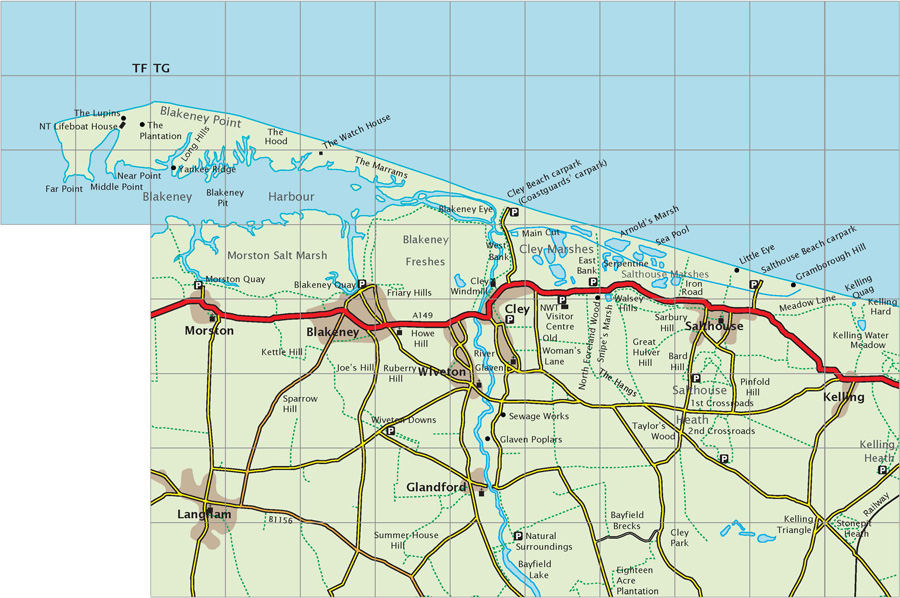
The Cley area consists of the Ordnance Survey square TG04 plus the tip of Blakeney Point. Also included are records from the whole of Kelling Heath, the eastern part of which extends beyond the TG04 boundary. |
Just click on the species name below. All names are in taxonomic order, or you can search for any part of the species name simply by using "Ctrl F". Once on a page, you can click left or right to the next species in order, or return to this page to search again.
Black Brant
Branta bernicla nigricans
Red-breasted Goose Branta ruficollis
North American Canada Goose Branta canadensis
parvipes/interior
Richardson’s Cackling Goose Branta hutchinsii hutchinsii
Ross's Goose Anser rossii
Snow Goose Anser caerulescens caerulescens/atlanticus
Lesser White-fronted Goose Anser erythropus
Greenland White-fronted Goose Anser albifrons flavirostris
Taiga Bean Goose Anser fabalis fabalis
Mandarin Duck
Aix galericulata
King Eider Somateria spectabilis
Surf Scoter Melanitta perspicillata
Marbled Duck Marmaronetta angustirostris
Red-crested Pochard Netta rufina
Ferruginous Duck Aythya nyroca
Ring-necked Duck Aythya collaris
Blue-winged Teal Spatula discors
Falcated Duck Mareca falcata
American Wigeon Mareca americana
Green-winged Teal Anas crecca carolinensis
Northern Bobwite Colinus virginianus
Quail Coturnix coturnix
Chukar Alectoris chukar
Little Bustard Tetrax tetrax
Great Spotted Cuckoo Clamator glandarius
Pallas's Sandgrouse Syrrhaptes paradoxus
Demoiselle Crane Grus virgo
Corncrake Crex crex
Spotted Crake Porzana porzana
Little Crake Zapornia parva
Black-winged Stilt Himantopus himantopus himantopus
American Golden Plover Pluvialis dominica
Pacific Golden Plover Pluvialis fulva
Killdeer Charadrius vociferus vociferus
Sociable Plover Vanellus gregarius
Greater Sand Plover Anarhynchus leschenaultii
Kentish Plover Anarhynchus alexandrinus alexandrinus
Little Whimbrel Numenius minutus
Long-billed Dowitcher Limnodromus scolopaceus
Great Snipe Gallinago media
Terek Sandpiper Xenus cinereus
Spotted Sandpiper Actitis macularius
Wilson's Phalarope Phalaropus tricolor
Red-necked Phalarope Phalaropus lobatus
Solitary Sandpiper Tringa solitaria
Marsh Sandpiper Tringa stagnatilis
Lesser Yellowlegs Tringa flavipes
Broad-billed Sandpiper Calidris falcinellus falcinellus
Red-necked Stint Calidris ruficollis
Buff-breasted Sandpiper Calidris subruficollis
Hudsonian Dunlin Calidris alpina hudsonia
Baird's Sandpiper Calidris bairdii
Pectoral Sandpiper Calidris melanotos
Semipalmated Sandpiper
Calidris pusilla
Western Sandpiper
Calidris mauri
Least Sandpiper
Calidris minutilla
White-rumped Sandpiper
Calidris fuscicollis
Cream-coloured Courser
Cursorius cursor cursor
Oriental Pratincole
Glareola maldivarum
Black-winged Pratincole
Glareola nordmanni
Collared Pratincole
Glareola pratincola pratincola
Long-tailed Skua
Stercorarius longicaudus longicaudus
Black Guillemot Cepphus grylle arcticus
Brünnich's Guillemot Uria lomvia
Sooty Tern
Onychoprion fuscatus fuscatus
Caspian Tern Hydroprogne caspia
Gull-billed Tern Gelochelidon nilotica nilotica
Whiskered Tern Chlidonias hybrida hybrida
White-winged Black Tern Chlidonias leucopterus
Lesser Crested Tern Thalasseus bengalensis torresii
Eastern Common Tern Sterna hirundo longipennis
Ross's Gull Rhodostethia rosea
Slender-billed Gull Chroicocephalus genei
Bonaparte's Gull Chroicocephalus philadelphia
Laughing Gull Leucophaeus atricilla
Franklin's Gull Leucophaeus pipixcan
Ring-billed Gull Larus delawarensis
Iceland Gull Larus glaucoides glaucoides
White-billed Diver Gavia adamsii
Black-browed Albatross Thalassarche m. melanophris
Albatross sp
Wilson's Petrel Oceanites oceanicus exasperatus
Storm Petrel Hydrobates pelagicus pelagicus
Cory's Shearwater Calonectris borealis
Great Shearwater Ardenna gravis
Balearic Shearwater Puffinus yelkouan mauretanicus
Barolo Shearwater Puffinus baroli
Fea’s Petrel Pterodroma feae/deserta
Black Stork Ciconia nigra
White Stork Ciconia ciconia
Brown Booby Sula leucogaster leucogaster
Glossy Ibis Plegadis falcinellus falcinellus
White Pelican Pelecanus onocrotalus
Little Bittern Botaurus minutus minutus
Night Heron Nycticorax nycticorax nycticorax
Squacco Heron Ardeola ralloides
Great White Egret Ardea alba alba
Cattle Egret Ardea ibis
Purple Heron Ardea purpurea purpurea
Alpine Swift Tachymarptis melba melba
Pacific Swift Apus pacificus pacificus
Pallid Swift Apus pallidus
Common or Pallid Swift Apus apus/pallidus
Dark-breasted Barn Owl Tyto alba guttata
Scops Owl Otus scops scops
Snowy Owl Bubo scandiacus
Honey Buzzard Pernis apivorus
Booted Eagle Hieraaetus pennatus
Goshawk Astur gentilis gentilis
Pallid Harrier Circus macrourus
Northern Harrier Circus hudsonius
Black Kite Milvus migrans migrans
Black-eared Kite Milvus migrans lineatus
White-tailed Eagle
Haliaeetus albicilla
Rough-legged Buzzard Buteo lagopus lagopus
Hoopoe Upupa epops epops
Bee-eater Merops apiaster
Red-footed Falcon Falco vespertinus
Arctic Peregrine Falco peregrinus tundrius/calidus
Gyr Falcon Falco rusticolus
Ring-necked Parakeet Psittacula krameri
|
A Work in Progress The plan is for every species, major subspecies and form of bird that has been recorded in the Cley area to have its own page detailing its status here. Currently, the non-passerines rare birds and scarce birds are being uploaded. Each has a heading photograph taken in the Cley Square (unless one has never been taken here or one is not available), a section summarising the records, and then a list of all of the records (as much as is practicable for the commoner scarcities). For the rarer species, concise details and observers' names are given for each record where known. Credited observers' names are those given in the annual British Birds rarities reports and Norfolk Bird Reports, plus others where known, from the Cley Bird Club database and elsewhere. Here, normally up to three observer names are given (occasionally up to five for special records) in alphabetical order, but with the initial finder's name moved to the front when known. The inclusion of observers' names brings the records 'alive', but this is a work in progress: if you know for certain who found a particular bird and it is not yet credited here correctly, or you think any other observers' names should be added or changed, please let me know. In due course, it is hoped to provide histograms summarising the records of all the scarce migrants and commoner rarities, but this will be done after all of the non-passerine and passerine rare birds and scarce birds have been uploaded, and after pages for all of the commoner birds have been added too. A few conventions different from those used in the Norfolk Bird Reports, for example, have been used here. Notably Kelling Water Meadow here refers to the pool itself and the water meadow immediately surrounding it. Kelling Hard, the Kelling Quag field, the NOA Pool and Meadow Lane Marshes all come under the name Kelling here, except where these names are specifically used. The small 'box' that appears before most bird names indicates that these are fully accepted full species. The absence of the box indicates birds that these birds are either currently regarded as subspecies or otherwise not fully accepted full species for some other reason as explained in the species text. Priority for the box is given to the commonest form of a species occurring here. Completion of this project will take some time. Meanwhile, please do take a browse of the non-passerines rare birds and scarce birds uploaded so far, and please do let me know your thoughts. |
|
|